


AEO and SEO both matter in 2026 for digital marketers. But for better visibility over AI search engines and Large Language Models (LLMs), implementing Answer Engine Optimization (AEO) techniques is a must.
Search Engine Optimization (SEO) has been trending for decades, but now, AEO has emerged as a newer strategy with the rise in AI-search adoption. With this shift, there are speculations that SEO is dead and AEO will rule now. But that’s not the truth.
Without strong foundational SEO, AEO drives results that are only half of its capacity. At the same time, SEO without AEO limits visibility in AI-driven discovery environments. This rounds off to the fact that AEO and SEO both are important in digital marketing today & beyond.
In this guide, we will understand AEO vs SEO, real-time applications, and best practices that help businesses stay on top of traditional search engines, as well as be visible on AI tools like Gemini, ChatGPT, etc.
Let’s dive in.
What is SEO and AEO?
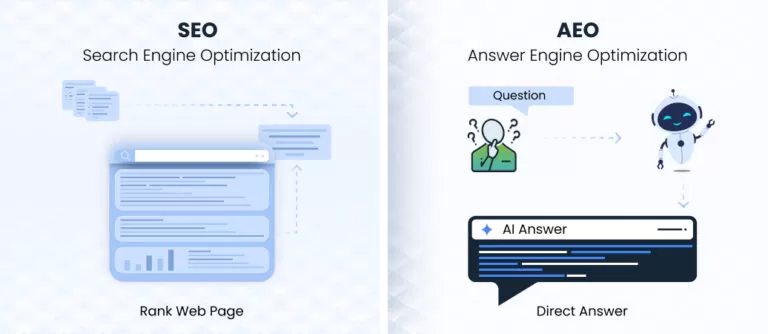
SEO means improving a website’s visibility in traditional search engines like Google. It mainly relies on keyword relevance, backlinks, technical performance, and user experience. The main goal here is to rank pages higher so users click through to the site.
Meanwhile, AEO means making content easy for AI systems to understand, extract, and present as direct answers. Instead of ranking a page, the goal here is to become the content source an AI trusts when generating responses.
In short, SEO is page-centric, and AEO is answer-centric.
SEO optimizes for crawlers and ranking algorithms, and AEO optimizes for LLMs, reasoning systems, and retrieval layers.
AEO vs SEO: Key Differences Digital Marketers Must Understand
| Aspect | AEO (Answer Engine Optimization) | SEO (Search Engine Optimization) |
|---|---|---|
| Primary goal | Become the trusted source for direct answers in AI-generated responses | Rank web pages higher in search engine results |
| Optimization focus | Answers, clarity, context, and semantic understanding | Pages, keywords, backlinks, and technical signals |
| Main platforms | AI search engines, LLMs, chat interfaces, voice assistants | Google, Bing, traditional search engines |
| User interaction | The user often gets the answer without clicking | User clicks through to a website |
| Content structure | Clear, concise, extractable answers within the content | Long-form pages optimized around topics |
| Success metrics | Mentions, citations, and visibility inside AI responses | Rankings, organic traffic, clicks, conversions |
| Role of keywords | Supportive, but meaning and intent matter more | Central to relevance and ranking |
| Dependency on authority | Built through accuracy, consistency, and topical expertise | Built through backlinks and domain strength |
| Content depth | Precision helps answer selection and trust | Depth helps rankings and engagement |
| Best use cases | Direct questions, definitions, explanations, and decision support | Research-heavy queries, comparisons, transactional searches |
Understanding these differences helps marketers avoid treating AEO as just “SEO with FAQs.”
Why Traditional SEO Optimization Alone Is No Longer Enough in 2026
Search behavior has changed fundamentally.
Users no longer rely only on search engines to explore topics. They ask questions directly inside AI tools. They expect synthesized answers, and not just a list of links where they have to open each link to get the exact answer.
But this does not mean traditional SEO has lost value. It means its role has shifted.
Today, ranking first on Google does not guarantee visibility in AI answers. Many AI systems rely on structured data, semantic clarity, and authoritative signals that go beyond classic on-page optimization.
In short, SEO alone optimizes for discovery, while AEO optimizes for inclusion. And brands that rely only on SEO optimization risk losing visibility in platforms where answers are generated, not searched.
If you are looking to implement SEO and AEO strategies for your brand without managing the implementation chaos, hire SEO experts from a reliable source. They’ll manage everything for you from fundamental SEO to modern AEO.
How AEO Optimization Helps Brands Win Visibility in AI-Generated Answers
AEO optimization focuses on making content understandable, quotable, and reliable for AI systems.
Here’s how implementing AEO on the content helps brands gain visibility:
- Directly answers user questions
Structuring content in a way that it responds clearly to specific questions, so that AI models can easily extract and reuse it for generating accurate responses. - Improves content clarity and context
AEO prioritizes plain language, defined terms, and logical flow so AI systems can understand meaning without ambiguity. - Building brand authority
Consistent coverage of a subject area helps AI systems associate a brand with expertise, not just isolated pages. - Supports zero-click and low-click discovery
Even when users do not click through, brands remain visible at the moment of decision-making. - Aligns content with conversational search patterns
AEO content mirrors how people naturally ask questions in AI tools, voice search, and chat interfaces. - Reduces dependence on traditional rankings alone
Visibility becomes more resilient across platforms where classic search positions no longer determine exposure.
This approach does not replace SEO. It extends it into environments where answers matter more than links.
Why SEO Optimization Still Plays a Critical Role in Search Performance
Despite the rise of AEO, SEO remains foundational.
Search engines still rely on crawling, indexing, and ranking. Backlinks still matter. Technical performance still affects visibility. Content depth still influences authority.
More importantly, AI systems do not exist in isolation. Many rely on indexed web content, structured markup, and search engine signals to validate information.
Strong SEO optimization ensures that content is discoverable, accessible, and trusted. Without it, AEO has no stable foundation.
This is why SEO optimization services remain critical for long-term growth, especially for competitive industries and transactional queries.
AEO vs SEO: Which One Drives Better ROI for Digital Marketers?
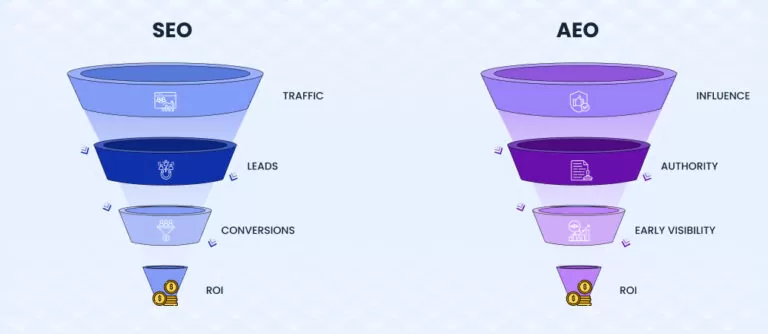
The ROI question depends on how the value is defined.
SEO delivers measurable traffic, leads, and conversions. Its ROI is easier to track and attribute.
While, AEO delivers influence, authority, and early visibility in emerging discovery channels. Its ROI shows up indirectly through brand recall, assisted conversions, and trust.
In 2026, marketers should not evaluate AEO vs SEO as an either-or investment, because the highest ROI comes from aligning both.
SEO captures demand. AEO shapes demand. Hence, brands that invest in both gain reach across the entire discovery lifecycle.
How AEO and SEO Work Best Together
One of the most effective AI optimization strategies includes strategically integrating AEO into existing SEO workflows.
Here’s why using both together benefits the brand:
- SEO research informs what topics matter.
- AEO defines how those topics are answered.
- SEO structures content for pages.
- AEO structures content for extraction.
And when both are aligned, content ranks well and gets referenced by AI systems.
Key AI Content Optimization Techniques for SEO and AEO in 2026
Optimizing content for AI search requires clarity of strategies rather than using a trial-and-error technique.
Here are some techniques to help you optimize content for AI:
- Content should answer questions directly before expanding.
- Definitions should be explicit and well-explaining.
- Claims should be supported with reasoning, not vague statements.
- Topical consistency matters more than volume.
- Pages should focus on one core subject and cover it thoroughly without dilution.
For a deeper understanding of AI-driven optimization, marketers can explore this guide on AI search optimization.
Plus, for additional LLM-specific techniques, you can go through our guide on the 9 best LLM SEO best practices.
These practices support both SEO and AEO without forcing artificial structures.
When Businesses Should Invest in AI Search Optimization Services
Not every business needs advanced AEO immediately. But certain signals indicate readiness:
- If a brand operates in a knowledge-driven industry, competes on expertise, or relies on long consideration cycles, AI visibility matters.
- If customers frequently ask complex questions before buying, AEO can influence decisions earlier than traditional SEO.
- If competitors are already appearing in AI-generated answers, waiting becomes risky.
In these cases, investing in AI search optimization services helps future-proof visibility while strengthening existing SEO foundations.
Final Verdict
AEO vs SEO is not a battle for dominance. It is a shift in responsibility.
SEO remains essential for discoverability, authority, and performance. AEO ensures that authority translates into visibility inside AI-driven answers.
In 2026, digital marketers should focus on building strong SEO foundations while adapting content for answer-based discovery. This balance allows brands to stay visible wherever users search, ask, or decide.
At TRooInbound, the approach is rooted in integration, not replacement. By aligning SEO fundamentals with AEO and AI search strategies, brands can build long-term visibility across search engines, LLMs, and emerging discovery platforms without sacrificing credibility or performance.
For businesses looking to strengthen their SEO foundation, working with a trusted partner or choosing to hire an SEO expert can accelerate results while ensuring readiness for AI-driven search.
Contact us today to explore how these strategies fit into a broader growth framework.